Kusama’s Place in Contemporary Art
From Post War Japan to Global Recognition
Yayoi Kusama’s journey into the art world began in Matsumoto, Japan, in the aftermath of World War II. With limited resources but an unwavering drive, she began creating intricate works that channeled psychological struggle into artistic form. In the 1950s, she made the radical decision to move to the United States a bold leap that placed her in the heart of New York’s avant garde scene.
Born in 1929 in Japan, Kusama trained in traditional painting before shifting into more radical modes of expression
Moved to New York in 1958, at a time when abstract expressionism and male artists dominated the scene
Held impactful solo exhibitions throughout the 1960s and 70s, often self financed in defiance of art world gatekeepers
Challenging a Male Dominated Art World
Despite being excluded from mainstream recognition for much of her early career, Kusama never deviated from her singular vision. Through performance art, large scale installations, and politically charged happenings, she asserted her place in a space that often sidelined avant garde women and international voices.
Her work tackled taboo topics like sexuality, mental illness, and war long before they were accepted subjects in mainstream art
Often staged protests and happenings that blurred the line between art and activism
Pushed against the boundaries of patriarchy and racism in the New York art scene of the 1960s
Shaping the Future of Installation Art
Kusama didn’t just adapt to new mediums she transformed them. Her immersive environments predated the popularity of installation art, laying the foundation for how spaces could become canvases. Her “Infinity Net” paintings evolved into mirrored rooms, foreshadowing the rise of experiential and participatory art in the 21st century.
Pioneered immersive, physically interactive installations in the 1960s and 70s
Continues to evolve the concept of space and perception well into her 90s
Directly influenced the rise of experiential art pop ups, social media ready exhibitions, and interactive museum design
Kusama’s impact is not only evident in gallery spaces but also in how we think about the relationship between artist, viewer, and space. Few artists have sustained such creative relevance across so many movements and decades.
The Power Behind the Polka Dots
For Yayoi Kusama, repetition isn’t just a visual device it’s a lifeline. Her use of dots, nets, and mirrored fields is less about decoration and more about survival. Each repeated mark speaks to a need for control, a way to quiet the chaos of her mind. Struggling with hallucinations and obsessive thoughts since childhood, Kusama turned to pattern as both an anchor and an amplifier something that made her pain visible, but also contained it.
The dots aren’t random. They mirror both microscopic cells and astronomical phenomena: the body and the cosmos. That duality is intentional. Her art isn’t about escaping reality. It’s about confronting it, obsessively, until it starts to make sense or collapse into infinity.
Kusama’s early “Infinity Net” paintings endless loops of tightly painted arcs introduced this relationship between repetition and scale. Alone in her New York studio in the 1960s, she would paint for hours, sometimes days, without rest. The nets stretch across the canvas like mantras, binding trauma into rhythm. These paintings didn’t just lay the groundwork for her later immersive work they were immersive in their own right, engulfing both the viewer and Kusama herself.
It’s this insistence on pattern on circling emotion instead of suppressing it that gives her work its punch. Obsession becomes method. The personal becomes universal. And the dots just keep going.
Infinity Rooms: A Revolution in Spatial Experience
Before “immersive” became a marketing buzzword, Yayoi Kusama built entire environments where the viewer wasn’t just welcomed they were swallowed whole. Her Infinity Mirror Rooms weren’t about passive observation. They were about dislocation, immersion, and perspective. You didn’t just see the art. You stood in it, reflected across endless planes, multiplied into vanishing points.
“Infinity Mirrored Room The Souls of Millions of Light Years Away” wasn’t just another installation. It marked a shift. Suddenly, art was an experience, an event. Long lines outside museums didn’t form for paintings on a wall they formed for 45 seconds alone in that room of cosmic repetition. It was more than visual; it was visceral. And it collided with social media right when people were learning how to film themselves being overwhelmed by beauty.
What started as avant garde experimentation became canon. Today, museums design for immersion. People expect impact, disorientation, something that reaches beyond the frame. Kusama didn’t chase that trend she made it. Her rooms gave new language to space: infinite, emotional, human. What once felt like novelty now feels like a necessity.
Global Reach & Institutional Embrace

Yayoi Kusama’s work isn’t just living in galleries it’s embedded in the DNA of global art institutions. In recent years, major retrospectives at the Tate Modern in London, the Broad Museum in Los Angeles, and Gropius Bau in Berlin have repositioned her as not just a pop culture fixture, but a touchstone for understanding contemporary visual culture. These exhibitions didn’t just highlight her career they reframed it as essential.
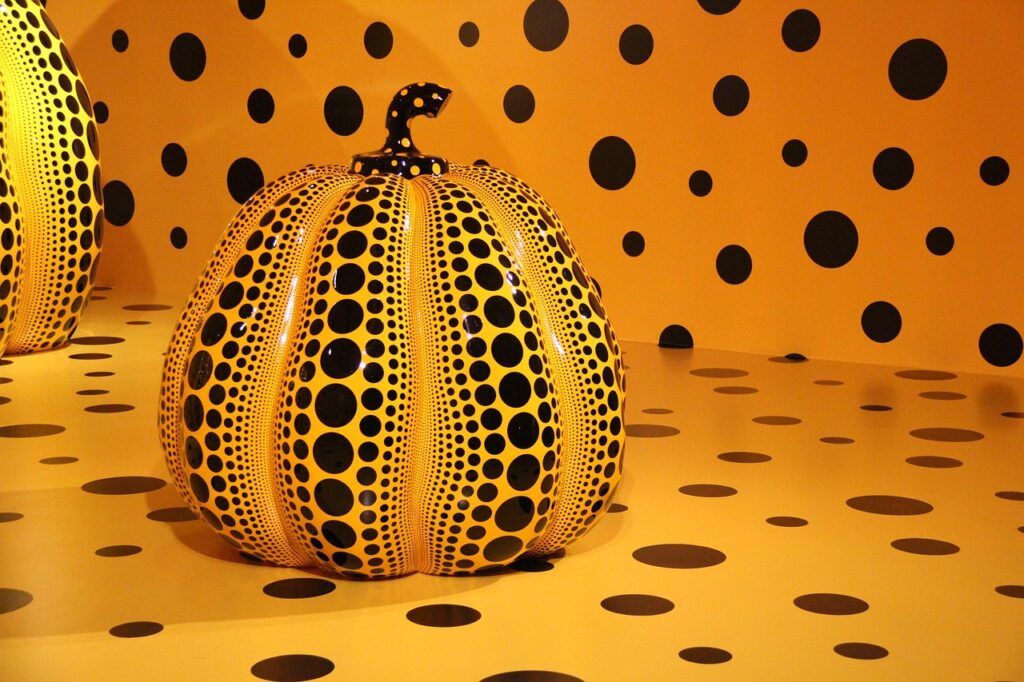
But the spotlight doesn’t flicker after the show moves on. Kusama’s influence has been made permanent through dedicated installations around the world. Her Infinity Mirror Rooms, pumpkin sculptures, and polka dot universes are on long term view in places like the Yayoi Kusama Museum in Tokyo, Inhotim in Brazil, and even the permanent collection at the Broad. These aren’t just attractions they’re anchors.
Museums know exactly what they’re doing. Kusama’s work draws lines around the block, floods feeds with selfies, and attracts audiences who might otherwise never step into a gallery. Her installations are immersive, emotionally accessible, and weirdly universal. That makes her a valuable gateway artist someone who pulls new generations into the museum experience with her mix of color, chaos, and clarity. Whether it’s through mirrors or pumpkins, the entrance into contemporary art for many starts with Kusama.
Kusama’s Influence on Future Generations
A Philosophy That Transcends Time
Yayoi Kusama’s work is not just remembered it reverberates through the minds of today’s creators. Her philosophy of endlessness and unapologetic vulnerability has influenced a wide array of contemporary artists, inspiring them to explore the boundaries of self, repetition, and space.
Artists today openly credit Kusama’s dedication to personal truth and limitless perspective
Her embrace of mental illness as part of her creative identity paved the way for more transparent artistic expression
Kusama’s motifs mirrors, patterns, and psychological depth continue to be echoed in new media and emerging formats
From Infinity Rooms to Experiential Art Hubs
There’s a direct artistic lineage from Kusama’s early Infinity Rooms to the immersive installations captivating audiences today. Before interactive experiences became a dominant art trend, Kusama had already built fully enveloping environments that shifted the viewer’s role from observer to participant.
Kusama’s spatial work redefined how we understand viewer involvement in art
Modern artists and collectives, such as teamLab and Meow Wolf, follow her immersive lead
The boundaries between art, architecture, and digital experience blur in ways Kusama anticipated decades ago
Echoes Across Creative Spheres
Kusama’s method and message extend well beyond the art world. Elements of her vision can be found rippling across fashion, film, and even scientific thought.
In Fashion
Designers from Louis Vuitton to emerging labels have incorporated Kusama’s polka dots and surreal motifs
She has herself collaborated with major fashion houses, bringing art into everyday wearables
In Film and Pop Culture
Filmmakers draw inspiration from her obsession with infinity and the surreal
Music videos, stage designs, and set cinematography reflect her immersive and psychological aesthetics
In Science and Technology
The concept of endless repetition and mirrored space resonates with themes in physics and cosmology
As immersive technology such as AR and VR develops, parallels to Kusama’s ideas of infinite environments grow more direct
Her work continues to shape not just what we see, but how we experience the world around us proving that Yayoi Kusama’s artistic vision is timeless.
Legacy Beyond Art
Yayoi Kusama is no longer just an artist she’s a cultural landmark. Through decades of self imposed exile, institutional rejection, and psychological struggle, she never silenced her voice. Her work and persona withstand mainstream trends, because they’re forged from something deeper: persistence, conviction, and pain. That combination made her, unmistakably, a symbol of resilience.
Kusama’s creativity isn’t escapist it’s cathartic. She has said that art is the reason she keeps living. Her dots, nets, and mirrored spaces are born from hallucinations and obsessions she’s wrestled with for a lifetime. Instead of hiding her mental illness, she folded it into her practice. The result is therapeutic not just for her, but for anyone who steps into one of her spaces and feels understood, even without words.
That powerful fusion of vulnerability and vision puts her in rare company. Think Leonardo da Vinci whose drawings blurred the boundary between art and scientific inquiry. Both saw the world as infinite and interconnected, dictated not by simplicity, but by pattern and complexity. Like da Vinci, Kusama’s compulsions became revelations. And like him, she didn’t wait for permission.
Kusama built her own world. The rest of us walked in.
The Infinite Echo
In 2026, Yayoi Kusama’s work still pulses with relevance not because of novelty, but because of truth. Her art doesn’t beg for attention; it demands time. While the world chases faster feeds and shallower scrolls, Kusama’s mirrored chambers and endless dots whisper something steadier: you are both everything and nothing all at once.
Her obsession with repetition wasn’t just aesthetic; it was existential. Dots, nets, mirrored rooms they were tools to dissolve the self, to stare down infinity without blinking. This idea of becoming part of something bigger and unknowable strikes a chord in today’s fractured culture. As society grapples with isolation, overstimulation, and the collapse of collective attention, Kusama’s work offers something rare: a still point.
That’s her real legacy. Not just the visuals. Not just the selfies. But the philosophical punch behind the patterns: the invitation to disappear in order to feel whole. Long after the queues dissolve and the installations dim, what lingers is her reminder that art can be both a mirror and a window one that looks outward, inward, forever.