Why 19th Century Art Needed a Shakeup
In 19th century France, the Académie des Beaux Arts dictated nearly every aspect of what could and couldn’t be considered “real art.” From technique down to subject matter, it was about strict lines, heavy finishes, and themes that stuck to classical, religious, or historical borders. Painters were expected to tell grand stories of Roman heroes or biblical scenes, not portray the street outside their window.
The Académie ran the Salon France’s premier art exhibition and it served as both gatekeeper and enforcer. If your painting didn’t align with the Académie’s ideals, it didn’t make the cut. No Salon meant no audience, no patrons, no future.
Many young artists hit a wall. The system felt stifling, formulaic. Brushwork had to be invisible. Composition followed rigid hierarchies. And heaven forbid you painted a working class woman enjoying her day in a park.
They started to ask: What if art could reflect life as it’s lived, not just as it’s idealized? What if light, motion, and feeling mattered more than perfect anatomy or heroic narratives?
It was a rebellion in slow motion but it had already begun.
Enter the Impressionists
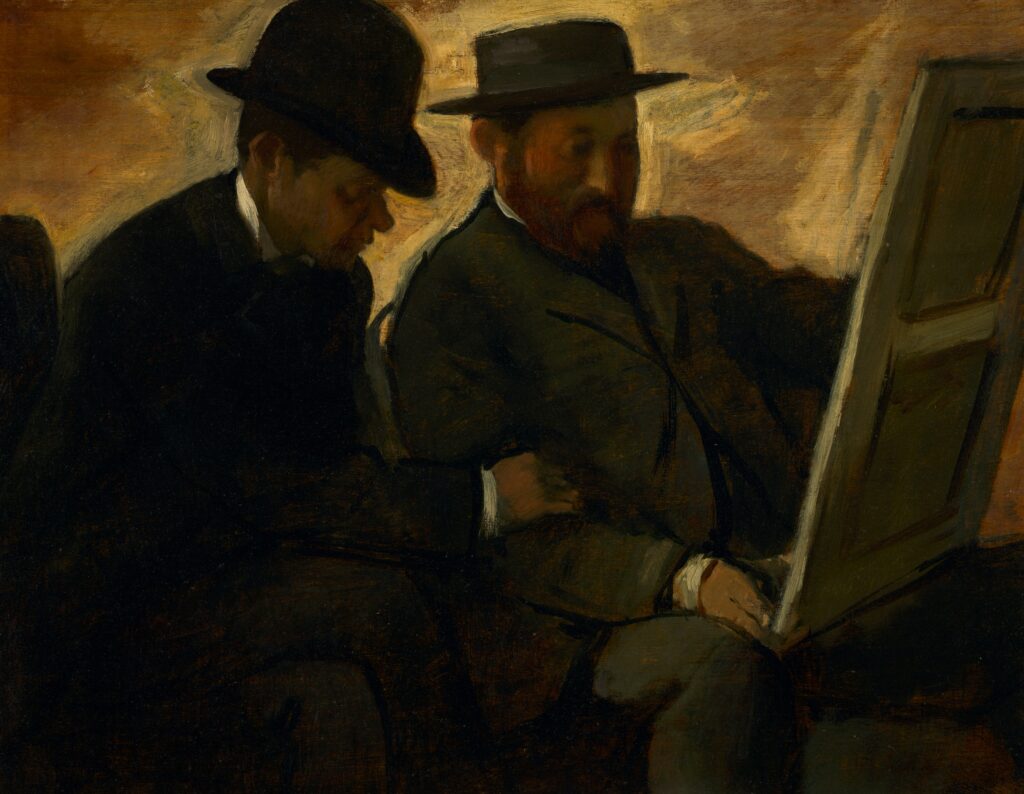
In the late 1800s, a small, determined group of artists broke ranks with the art establishment. Claude Monet, Edgar Degas, Camille Pissarro, Berthe Morisot, and Pierre Auguste Renoir didn’t just want to paint they wanted to paint differently. Instead of biblical scenes or mythological epics, they turned their attention to cafés, train stations, and the rhythm of everyday Paris. Real life, in real time.
Their technique deviated hard from academic expectations. Brushstrokes were quick and visible. Compositions felt spontaneous, open, and airy. The palette got lighter colors more vivid, shadows touched with blue instead of black. This wasn’t cleaning up the world to fit art. It was letting art come messy and alive, as the eye actually sees it.
Painting outdoors what the French called plein air was the linchpin. Portable paint tubes and collapsible easels meant they could chase light, not just recreate it. Mornings on the Seine, dusks in Montmartre, thick fog rolling through the Gare Saint Lazare. What mattered was immediacy, not perfection.
They weren’t just rejecting the rules. They were rewriting what it meant to be modern.
Rejected Then, Revered Now

In 1863, the French art world hit a boiling point. The state run Paris Salon had dismissed thousands of submitted works, triggering outrage among a generation of artists fed up with academic gatekeeping. Under public pressure, Emperor Napoleon III allowed a separate exhibition the Salon des Refusés, or “Exhibition of the Refused.” It was meant as a compromise. Instead, it sparked a cultural detonation.
Among the exhibits was Claude Monet’s rough, luminous seascape titled “Impression, Sunrise.” Critics mocked it, using the word “impression” as an insult. They saw the loose brushwork and hazy composition as unfinished, unserious a threat to accepted standards of polish and perfection. Traditionalists’ outrage was swift and sharp. But mockery peeled back the door to curiosity.
Though derided at first, the raw quality of these works captured something fresh: a fleeting light, an ordinary moment, an honest gaze. While institutions clung to history and mythology, these painters focused on real life as they saw it. The public began to look twice. Within a decade, the rejection badge had become a rebel’s brand. What began in a side exhibit of outcasts morphed into one of the most influential movements in art history.
What Made It So Revolutionary
Impressionism wasn’t subtle about its rebellion. It threw a wrench into everything the Academy held sacred. Where traditional painters prized precision and clean outlines, the Impressionists chased after light and color flickering, changing, imperfect. Shadows weren’t black anymore; they were blue, violet, green. Detail gave way to sensation.
Instead of stiff portraits and staged mythology, these artists captured actual movement. A dancer mid spin. A train just leaving the station. A gust of wind bending grass across a field. These moments weren’t frozen they pulsed.
And the view? It was personal. No more idealized countryside or polished grandeur. Impressionists painted how they saw the world sometimes blurred, sometimes messy, always immediate. They weren’t just recording what was there. They were showing what it felt like to be standing there, right then.
So art stopped being a report and started being an experience. That was the revolution. Not in what they painted, but how and why.
Legacy in 2026 and Why It Still Matters
Impressionism didn’t just change how we look at art it changed who gets to decide what art is in the first place. Its radical departure from formal technique and academic themes opened the floodgates for generations of artists willing to push back, break rules, and redefine boundaries. That spirit part rebellion, part revolution set the tone for modern art’s countless offshoots.
Movements like Dadaism carried the torch, swapping beauty for absurdity and precision for protest. (For more on that pivot, see What Defined the Dada Movement and Why It Still Matters.) Artists weren’t just reacting to aesthetics they were responding to politics, war, and society itself. That impulse to challenge power structures through creativity still echoes loud today.
Jump to the current moment: digital artists, meme makers, NFT creators. They may not be painting lilies in the light of day, but the ethos is familiar. It’s the same instinct to bypass institutions, build direct followings, and treat software like a canvas. Impressionism made room for all of it not by trying to be different for its own sake, but by refusing to be told no.
Takeaways for Today’s Creatives
Art doesn’t follow rules. It rewrites them. The Impressionists proved that much when they tossed out rigid conventions in favor of raw observation, emotion, and bold experimentation. They didn’t wait for permission and neither should you. If you find yourself boxed in, maybe the box needs breaking.
What lasts isn’t always what’s trending. The critics of the 1870s laughed at Monet’s blurry sunrises, but he’s still in every major museum more than a century later. Authenticity, even when unpopular, sticks around. It resonates. It stretches further than surface level praise ever can.
Frustration breeds movement. When enough artists reject the status quo, something shifts. That’s not just history. It’s a pattern. Whether it’s paint on canvas or pixels on a screen, the next big leap often begins when someone finally says, “This isn’t working for me.”
So make your own rules. Stick by your voice, even if no one claps at first. The culture you want to see might not exist yet.
 Brian Ochoaller writes the kind of creative inspiration from the past content that people actually send to each other. Not because it's flashy or controversial, but because it's the sort of thing where you read it and immediately think of three people who need to see it. Brian has a talent for identifying the questions that a lot of people have but haven't quite figured out how to articulate yet — and then answering them properly.
They covers a lot of ground: Creative Inspiration from the Past, Art Movements Explained, Exhibition Reviews and Highlights, and plenty of adjacent territory that doesn't always get treated with the same seriousness. The consistency across all of it is a certain kind of respect for the reader. Brian doesn't assume people are stupid, and they doesn't assume they know everything either. They writes for someone who is genuinely trying to figure something out — because that's usually who's actually reading. That assumption shapes everything from how they structures an explanation to how much background they includes before getting to the point.
Beyond the practical stuff, there's something in Brian's writing that reflects a real investment in the subject — not performed enthusiasm, but the kind of sustained interest that produces insight over time. They has been paying attention to creative inspiration from the past long enough that they notices things a more casual observer would miss. That depth shows up in the work in ways that are hard to fake.
Brian Ochoaller writes the kind of creative inspiration from the past content that people actually send to each other. Not because it's flashy or controversial, but because it's the sort of thing where you read it and immediately think of three people who need to see it. Brian has a talent for identifying the questions that a lot of people have but haven't quite figured out how to articulate yet — and then answering them properly.
They covers a lot of ground: Creative Inspiration from the Past, Art Movements Explained, Exhibition Reviews and Highlights, and plenty of adjacent territory that doesn't always get treated with the same seriousness. The consistency across all of it is a certain kind of respect for the reader. Brian doesn't assume people are stupid, and they doesn't assume they know everything either. They writes for someone who is genuinely trying to figure something out — because that's usually who's actually reading. That assumption shapes everything from how they structures an explanation to how much background they includes before getting to the point.
Beyond the practical stuff, there's something in Brian's writing that reflects a real investment in the subject — not performed enthusiasm, but the kind of sustained interest that produces insight over time. They has been paying attention to creative inspiration from the past long enough that they notices things a more casual observer would miss. That depth shows up in the work in ways that are hard to fake.